MAPK13
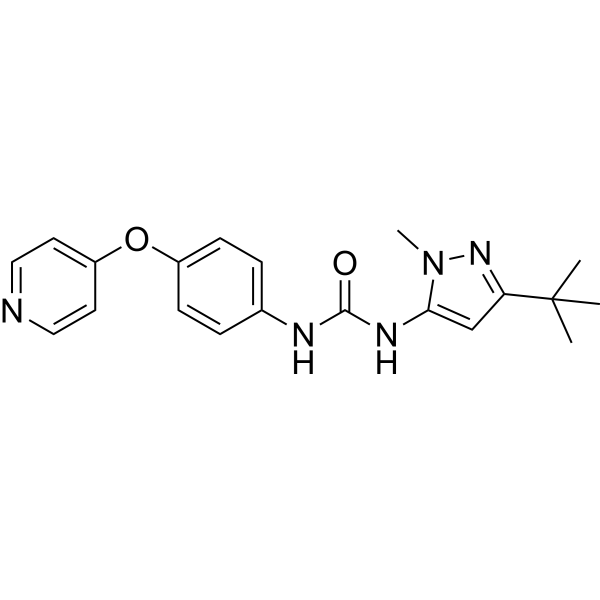
Mitogen-activated protein kinase 13 (MAPK13), also known as p38δ, is a member of the p38 MAPK subfamily that mediates cellular responses to stress and inflammatory stimuli[1][2]. MAPK13 regulates key biochemical pathways, including the serine synthesis pathway (SSP) via phosphorylation of phosphoglycerate dehydrogenase (PHGDH), leading to its degradation through chaperone-mediated autophagy, thereby modulating redox balance and cellular metabolism under liver injury conditions[3]. Mechanistically, MAPK13 contributes to IL-13-induced mucus production in airway epithelial cells by activating downstream transcriptional programs[4]. In immune regulation, MAPK13 phosphorylates transcription factor TCF1, promoting stem-like T-cell expansion and enhancing antitumor immunity in tumor microenvironments[5][6]. Compared with related p38 isoforms MAPK11, MAPK12, and MAPK14, MAPK13 exhibits distinct tissue-specific expression, epigenetic regulation, and substrate selectivity, which underlies its unique involvement in cellular metabolism, airway inflammation, and T-cell stemness[1][3][5]. Pathophysiologically, MAPK13 is implicated in drug-induced liver injury, cholestatic liver injury, chronic allograft vasculopathy, airway inflammatory diseases, diabetic wound healing, and cancer progression, where its inhibition or modulation has demonstrated protective or therapeutic potential[3][5][7][8]. Small molecule inhibitors targeting MAPK13 have been developed to reduce mucus overproduction and enhance rapamycin efficacy in cancer cells, highlighting its relevance for experimental and translational applications[4][8]. Collectively, MAPK13 serves as a critical stress-responsive kinase with isoform-specific functions, making it a valuable target for research in metabolism, inflammation, and immune regulation[1][3][5][8].
Verweise:
- [1]. Fernández-Aroca DM, et al. MAPK11 (p38β) is a major determinant of cellular radiosensitivity by controlling ionizing radiation-associated senescence: An in vitro study. Clin Transl Radiat Oncol. 2023 Jun 2;41:100649. [Content Brief]
- [2]. Wang S, et al. The role of MAPK11/12/13/14 (p38 MAPK) protein in dopamine agonist-resistant prolactinomas. BMC Endocr Disord. 2021 Nov 23;21(1):235. [Content Brief]
- [3]. Xing R, et al. MAPK13 phosphorylates PHGDH and promotes its degradation via chaperone-mediated autophagy during liver injury. Cell Discov. 2025 Feb 18;11(1):15. [Content Brief]
- [4]. Alevy YG, et al. IL-13-induced airway mucus production is attenuated by MAPK13 inhibition. J Clin Invest. 2012 Dec;122(12):4555-68. [Content Brief]
- [5]. Sun L, et al. LRP11 promotes stem-like T cells via MAPK13-mediated TCF1 phosphorylation, enhancing anti-PD1 immunotherapy. J Immunother Cancer. 2024 Jan 25;12(1):e008367. [Content Brief]
- [6]. Yi W, et al. Targeting the Mapk13-Tcf1-Slc7a5 Axis via One-Carbon Metabolic Regulation to Prevent Chronic Allograft Vasculopathy. Adv Sci (Weinh). 2026 Mar;13(17):e20815. [Content Brief]
- [7]. Tran T, et al. Hyperglycemia Modulates the Expression of MAPK13, TSP1, and CXCR2 During Wound Healing in Sprague Dawley Rats. Biology (Basel). 2025 Dec 23;15(1):26. [Content Brief]
- [8]. Kim J, et al. MAPK13 stabilization via m6A mRNA modification limits anticancer efficacy of rapamycin. J Biol Chem. 2023 Sep;299(9):105175. [Content Brief]
All Product Categories
-
MAPK13 Verwandte Produkte (1)
Verwandte Produkte (1)